Why Time on Feet Matters More Than Distance
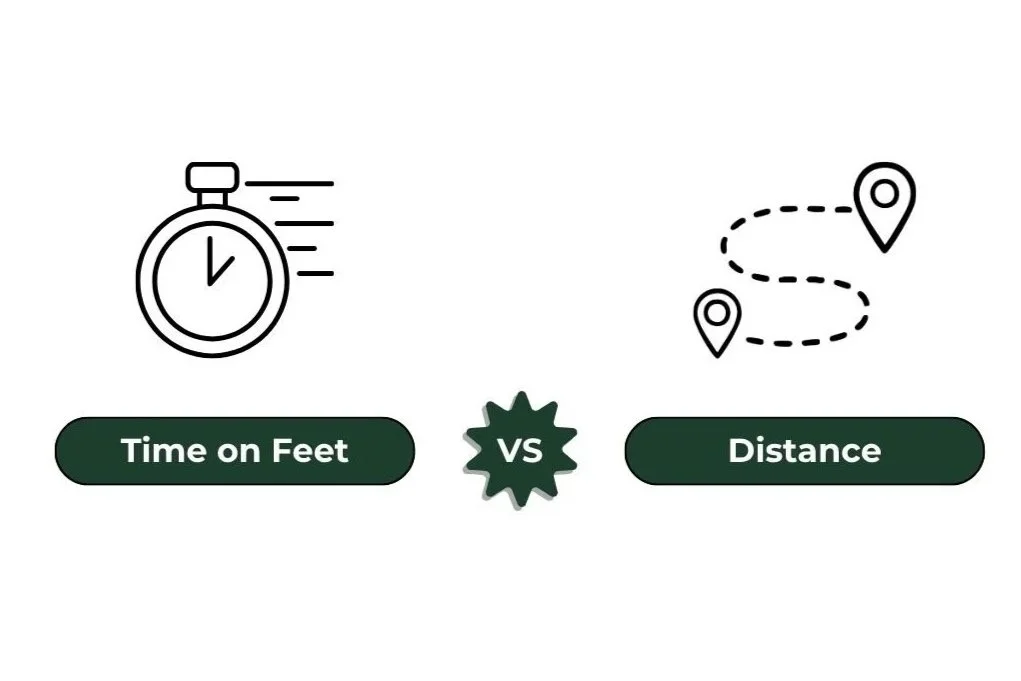
One of the biggest debates in running is time on feet versus distance.
Let’s break this down. And to be clear, this is written for new runners, beginner runners, and those coming back after time away. These concepts can also apply to more experienced runners at the start of a training block.
At Wayfinder, this is simple. Time on feet comes first.
Let’s be honest. Life is busy. You are likely balancing work, responsibilities, and commitments while having limited time and energy. The last thing you need is a training plan that stresses you out!
Running should fit into your life, not take it over. This is where time on feet becomes crucial.
Your Body Does Not Understand Miles
It is important to understand this. Your body does not know what a mile is. It does not know what pace you are running.
Your body understands effort. It understands stress.
Every run you do places a certain amount of stress on your body. That stress requires adequate recovery. That cycle is what drives progress.
To learn more about stress and recovery read: Stress, Rest, Repeat: How Runners Build Strength and Avoid Burnout.
What Is Time on Feet?
Time on feet is exactly what it sounds like. You run for a set amount of time. When the time is up, the run is over.
This approach is simple, but it is incredibly effective.
It is especially beneficial for runners who move at a slower pace.
Let’s say Runner A and Runner B both set out to run 3 miles.
Runner A runs a 14 minute mile and Runner B runs a 9 minute mile.
It would take Runner A longer to complete the 3 miles than Runner B.
Therefore, time on feet was increased for Runner A.
When time spent doing an activity increases so does overall stress and recovery demands.
Training by time instead of distance allows you to:
Train at your current level without comparison
Control total stress on the body
Build consistency without overdoing it
This ensures sustainable (and safe) progress.
What Is Distance Based Training?
Distance based training focuses on completing a set number of miles.
This approach has a place. It works well when you have already built a solid running foundation and are training for a specific goal.
It can help build muscular endurance and introduce more structured workouts like pace-specific efforts.
But for most beginners, it is not where you start.
Distance based training becomes more relevant when:
You are preparing for a race
You have performance goals tied to pace or time
Your body is already adapted to consistent running
Why Time on Feet Works for Beginners
If you are new to running or coming back after extended time off, especially in a season of life where your time and energy are limited, you do not yet have a current running base.
That means:
Your body has not yet adapted to the training load
Recovery takes more time
When you focus on distance too early, you risk doing too much too soon.
Time on feet solves that.
When you run based on time, a few important things happen:
You reduce pressure and pacing anxiety
You adjust naturally based on how you feel
You stay more consistent week to week
Your endurance builds gradually
You lower your risk of injury and burnout
You complete the full intended effort without rushing
If your plan calls for 30 minutes, you run for 30 minutes. Not faster. Not shorter. Just consistent effort.
That consistency is what builds real progress.
Effort Over Pace
This is one of the core principles at Wayfinder Running Co. Read more about The Wayfinder Method.
Time on feet keeps your focus where it should be. On effort.
Weather, terrain, sleep, stress, nutrition, hydration, all of these impact your pace on any given day.
When you chase distance or pace, you're ignoring those variables.
When you run by time, you listen to your body. You meet yourself where you are that day.
And that is how running becomes sustainable.
A More Enjoyable Way to Run
There is also a mental shift that happens.
When you are chasing distance, you are often counting down miles. Keeping an eye on your watch. Pushing to hit an arbitrary number. That can create unnecessary pressure.
When you run for time, you stay present. You move through the run instead of trying to finish it as quickly as possible. Running faster or slower will not make the 30 minutes go any faster or slower.
For many runners, this is the shift that takes running from something they struggle through to something they actually enjoy.
What About Half Marathon Training?
For more experienced runners or those training for longer distances like the half marathon, time on feet still plays a major role.
Most runners will not run the full race distance before race day. But simulating the time you expect to be out there can build both physical and mental confidence.
That matters more than simply checking off miles.
When Distance Does Make Sense
Distance is not the enemy. It just needs to be used at the right time.
Distance based training becomes more useful:
Later in a training cycle
When preparing for a specific race
When working toward pace or performance goals
At that stage, your body is ready for it.
The Bottom Line
A balanced approach often looks like:
Time based runs for base building and recovery
Distance for long runs and specific efforts or structured workouts
Time on feet is the safer, more effective way to build a running foundation. It keeps you consistent. It keeps you healthy. It keeps you coming back.
And that is what leads to progress.
At Wayfinder Running Co., we use a blend of time and distance depending on the individual and their goals. The best training plan is the one that keeps you healthy, motivated, and consistent.
Bringing It Back to Wayfinder Running Co.
At Wayfinder Running Co., training is built around consistency, adaptability, and sustainability.
Whether you are just starting out, building consistency, logging everyday miles or training for a half marathon, your plan should reflect what your body needs to progress over time.
That means:
Knowing when to push
Knowing when to adjust
Building a routine that is sustainable
If you are looking for structure, guidance, or support, Wayfinder Running Co. offers personalized run coaching and training plans designed to meet you where you are.
Inside 1:1 coaching, you will:
Receive a fully customized running plan
Ability to adjust your training based on your schedule, energy, and progress
Learn how to navigate challenges in real time
Build confidence in your decision-making as a runner
Because progress is not about doing more. It is about doing what works, consistently.
Start your Wayfinder journey and apply for 1:1 coaching today.
Keep Moving Forward,
~ Coach Lauren