Stress, Rest, Repeat: How Runners Build Strength and Avoid Burnout
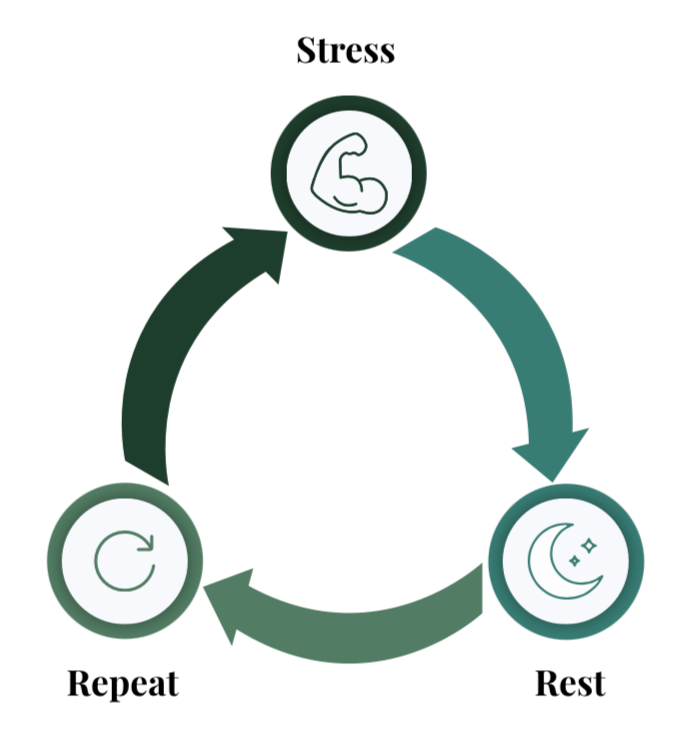
Fitness is not built through constant intensity. It is built through a cycle: stress, rest, repeat.
For runners, understanding this cycle is essential for building endurance, avoiding injury, and making long-term sustainable progress.
The Role of Stress in Training
When you train, whether that is running, strength training, or cycling, you are introducing stress to the body. For purposes of this article we will stick to running as the example.
With each step you take, with every muscle contraction (and relaxation), the impact creates physical stress on the body. That stress breaks down muscle fibers, tendons and ligaments and creates micro-tears. This breakdown of muscle fibers, tendons and ligaments is a normal part of the process.
Once you complete your run, the micro-tears start to repair themselves and create the stimulus for growth. In other words, the fibers start to grow back stronger.
The stress part of this equation is what most runners focus on. Logging miles. Completing workouts. Pushing effort.
But stress is only one part of the cycle.
The Role of Rest in Training
Although a common misconception, growth does not happen during the workout. Growth happens during recovery or rest.
After your run, your body triggers an inflammatory process which allows your body to repair, rebuild, and adapt to the stress you introduced. It’s signaling the muscle fibers, tendons and ligaments to repair themselves and to grow back stronger. This is when the true growth happens.
A common issue runners run into (no pun intended), is that they assumed they put in the work so now they can sit back and let the gains work for them. This can lead to issues down the road. Recovery should be intentional.
Recovery is not one-size-fits-all. It might look like:
An easy run
Cross-training
Foam rolling
Sleep
Stretching
Or complete rest
Recovery is highly individualized and depends on the level of stress placed on your body, your fitness level, etc.
If you want to benefit from your training, you have to give your body the space and time to absorb it.
The body needs time to absorb the work, if your body is constantly overworking, it will not be able to keep up with your body’s natural repair cycle.
If you do not allow your body sufficient recovery time, you can cause more damage leading to decreased performance and injury.
The Missing Piece: Repeat
The final piece in the cycle is repeat.
Not in a rigid or forced way, but in a way that builds a sustainable habit.
This is where consistency comes into play.
Consistency is not about doing more (read that one more time). It is about doing what your body and mind can sustain, again and again.
What Runners Often Get Wrong
As runners and endurance athletes, we tend to emphasize stress and overlook rest. I have been there myself!
But the more stress you introduce, the more intentional your recovery needs to be.
It is also important to remember that stress is not just physical. Stress is influenced by how you feel and how you respond to your environment.
One week your run may feel great and the next not so much. That does not mean you are going backwards or losing fitness. It is often a signal that your body needs something different (i.e., more recovery, fuel, sleep, etc.).
Remember that recovery is part of the process!!
Learning to Adjust
Learning to adjust is something I had to learn the hard way.
As an athlete, it took getting injured for me to truly respect this process. To listen. To adjust. To adapt.
Many endurance athletes struggle with this.
We need to learn to reframe recovery.
We should not look at a rest day as ‘wasted’. As mentioned above, recovery is essential and it is not one-size fits all.
Recovery is when the body adapts to the stress and progress and growth starts to compound.
A few ways to reframe recovery:
Instead of taking a day off from movement, incorporate some light movement such as walking, swimming, yoga or cycling. Just ensure you keep your effort easy to avoid putting additional stress on the body. This light movement promotes blood flow and can aid in recovery.
Perform mobility exercises or foam roll to break up the muscle fascia and promote blood flow and reduce muscle soreness.
Sleep is the most underrated recovery tool. Aim for seven to nine hours of sleep, if possible.
Progress is not built through constant intensity. It is built by understanding when to move forward and when to step back. Only when we understand this, we can mature as athletes.
Bringing It Back to Wayfinder Running Co.
At Wayfinder Running Co., training is built around consistency, adaptability, and sustainability.
Whether you are just starting out, building consistency, logging everyday miles or training for a half marathon, your plan should reflect what your body needs to progress over time.
That means:
Knowing when to push
Knowing when to adjust
Building a routine that is sustainable
If you are looking for structure, guidance, or support, Wayfinder Running Co. offers personalized run coaching and training plans designed to meet you where you are.
Inside 1:1 coaching, you will:
Receive a fully customized running plan
Ability to adjust your training based on your schedule, energy, and progress
Learn how to navigate challenges in real time
Build confidence in your decision-making as a runner
Because progress is not about doing more. It is about doing what works, consistently.
Start your Wayfinder journey and apply for 1:1 coaching today.
Keep Moving Forward,
~ Coach Lauren